
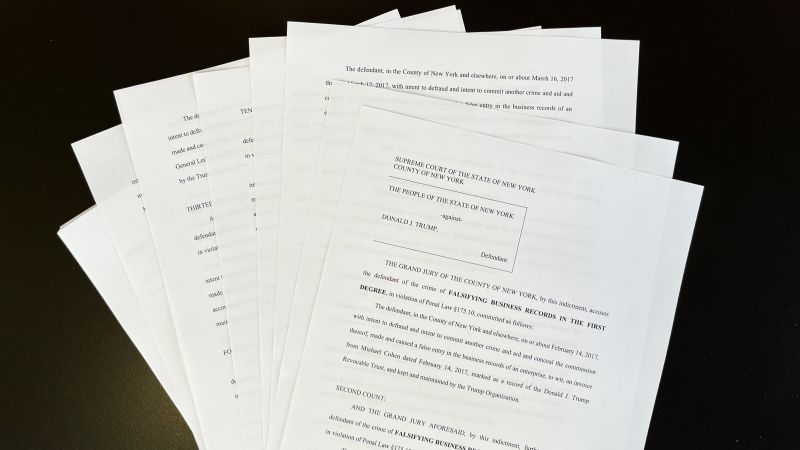
Overview of the Indictment
A New York grand jury has publicly released an indictment against former President Donald Trump, marking a significant development in a case stemming from a 2016 hush money payment. The indictment, unsealed in a Manhattan courtroom, charges the former President with 34 felony counts of falsifying business records in the first degree. These charges are related to payments made to an adult film actress shortly before the 2016 presidential election, allegedly to conceal information that could have been damaging to his campaign.
The charges allege that Trump orchestrated a scheme to illegally influence the 2016 election by making payments to suppress negative information. Prosecutors contend that these payments were then disguised as legal expenses within the Trump Organization's financial records, thereby falsifying business documents. Each of the 34 counts corresponds to a specific entry in business records, such as invoices, ledger entries, and checks, which prosecutors argue were intentionally mischaracterized.
Key Allegations and Legal Framework
The core of the prosecution's argument rests on the claim that the falsification of business records was not merely an administrative error but was done with the intent to commit or conceal another crime. Under New York law, falsifying business records can be elevated from a misdemeanor to a felony if the intent was to defraud and to commit or conceal another crime. While the indictment itself does not explicitly detail the underlying crime, legal analysts widely speculate it pertains to violations of campaign finance laws.
Prosecutors are expected to argue that the hush money payments constituted illegal campaign contributions, as they were allegedly made to benefit Trump's presidential campaign and were not properly disclosed. The indictment suggests a pattern of behavior aimed at concealing the payments, involving multiple individuals and entities. Michael Cohen, Trump's former attorney, who previously pleaded guilty to federal charges related to these payments, is anticipated to be a key witness for the prosecution.
The Timeline of Events Leading to the Indictment
The investigation into the hush money payments has a complex history, dating back several years. It gained renewed momentum under Manhattan District Attorney Alvin Bragg, who inherited the case from his predecessor. The grand jury began hearing evidence in early 2023, leading to the historic indictment.
- January 2018: The Wall Street Journal reports on a $130,000 payment made by Michael Cohen to adult film actress Stormy Daniels (Stephanie Clifford) in October 2016.
- August 2018: Michael Cohen pleads guilty to federal charges, including campaign finance violations related to the hush money payment, stating he made the payment at Trump's direction.
- July 2019: Federal prosecutors in New York close their investigation into the payments without charging Trump.
- March 2021: Manhattan District Attorney Cyrus Vance Jr. begins a new investigation, focusing on state-level charges.
- January 2022: Alvin Bragg takes over as Manhattan District Attorney and continues the investigation.
- March 2023: The Manhattan grand jury begins hearing testimony related to the hush money case.
- March 30, 2023: The grand jury votes to indict Donald Trump.
- April 4, 2023: The indictment is unsealed, and Trump is formally arraigned.
Legal and Political Ramifications
This indictment marks the first time a former U.S. President has faced criminal charges. The legal proceedings are expected to be lengthy and complex, with numerous motions and potential appeals. The defense team for the former President has consistently maintained his innocence, asserting that the payments were personal and not campaign-related, and that the charges are politically motivated.
The political implications of this indictment are substantial, particularly as Trump is a declared candidate for the 2024 presidential election. The case is likely to dominate political discourse and could influence public perception of the former President and the upcoming election cycle. Legal experts are divided on the strength of the prosecution's case, with some noting the difficulty of proving felony falsification of business records without a clear underlying crime conviction. Others argue that the evidence, particularly Cohen's testimony and the documentation, presents a formidable challenge for the defense.
“This indictment represents an unprecedented moment in American legal and political history. The prosecution faces the challenge of clearly demonstrating the intent to defraud and to commit or conceal another crime, while the defense will undoubtedly argue political persecution and the personal nature of the payments.”
The unsealing of the indictment provides a clearer picture of the specific charges and the legal strategy the prosecution intends to pursue. As the case moves forward, it will undoubtedly remain a focal point of national attention, with its outcome potentially setting significant precedents for future political and legal accountability.
Source: CNN
Related Articles
 politics
Senator John Fetterman Details Personal Battle with Depression Post-Election Victory
 politics
Finland's Parliamentary Election Concludes with Shift in Political Landscape
 politics
French Minister's Playboy Interview Ignites Political Debate Amid National Crisis
 politics