
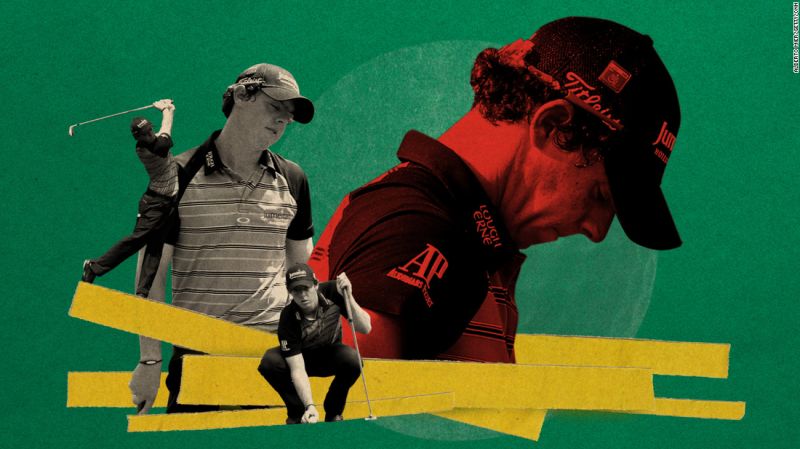
Rory McIlroy's Defining Masters Moment
In 2011, a then 21-year-old Rory McIlroy appeared poised to secure his first major championship at the Masters. Entering the final round at Augusta National with a commanding four-shot lead, the young Northern Irishman seemed destined for victory. Despite an initially shaky start to his final 18 holes, he maintained a one-shot advantage at the halfway point of the round. However, a wayward drive on the 10th hole, veering into the trees, initiated a dramatic downturn in his performance. Over the subsequent three holes, McIlroy dropped six shots, ultimately concluding the day tied for 15th place. This sudden reversal of fortune at such a crucial stage became a significant, albeit challenging, learning experience in his burgeoning career.
Historical Precedents of Golfing Setbacks
McIlroy's experience, while impactful, is not unique in the annals of golf. The sport's history is replete with instances where leading contenders have seen victory slip away under pressure. These moments underscore the mental fortitude required at the highest levels of competition.
Sam Snead's Elusive US Open
Sam Snead, a legendary figure with seven major championships and 82 PGA Tour wins, famously never captured the US Open title. In 1947, during an 18-hole playoff against Lew Worsham, Snead held a two-shot lead with three holes remaining. Despite this advantage, he was unable to close it out, ultimately missing a putt from inside three feet on the final hole, which cost him the championship.
Arnold Palmer's 1966 US Open Heartbreak
Even a titan of the sport like Arnold Palmer experienced significant setbacks. At the 1966 US Open, Palmer carried a substantial seven-shot lead into the back nine. However, a series of bogeys on five of the next seven holes allowed Billy Casper to draw even, forcing an 18-hole playoff. In the subsequent playoff, Palmer again faltered, dropping four shots over a three-hole stretch, leading to a four-stroke defeat against Casper.
Ed Sneed's 1979 Masters Near Miss
Ed Sneed, unrelated to Sam Snead, faced a similar fate at the 1979 Masters. Leading by three shots with three holes left to play, Sneed uncharacteristically bogeyed all three, forcing a sudden-death playoff. This was the first time such a format was used at Augusta. Debutant Fuzzy Zoeller ultimately claimed victory over Sneed and Tom Watson. For Sneed, this would represent his closest brush with major championship glory.
Scott Hoch's Infamous 1989 Masters Putt
The 1989 Masters featured another memorable playoff moment involving Scott Hoch. In a sudden-death playoff on the 10th hole against Nick Faldo, Hoch had a golden opportunity to win. After Faldo found a bunker, Hoch had two chances to sink a 25-foot putt for victory. His first putt left him within two feet of the hole, but his subsequent short putt agonizingly lipped out. Faldo then birdied the next hole, securing his victory and leaving Hoch to lament a missed opportunity.
Mark Calcavecchia's Ryder Cup Ordeal (1991)
The 1991 Ryder Cup witnessed a dramatic turn for Mark Calcavecchia. Leading Colin Montgomerie by four holes with four to play, Calcavecchia seemed assured of a crucial point for the American team. However, he lost all four remaining holes, resulting in a halved match. Despite his personal disappointment, the US team ultimately secured a narrow victory after Bernhard Langer missed a critical putt for Europe.
Greg Norman's 1996 Masters Collapse
Greg Norman's performance at the 1996 Masters remains one of golf's most famous collapses. After leading the tournament for the first three rounds and holding a six-shot lead over Nick Faldo entering the final day, Norman maintained a four-stroke advantage with 11 holes remaining. Yet, a series of bogeys and a double bogey allowed Faldo to seize a two-shot lead without even making a birdie himself. Despite a brief rally, Norman's fate was sealed with another double bogey on the 16th hole, as Faldo cruised to a five-shot victory.
Jean Van De Velde's British Open Calamity (1999)
Jean Van De Velde's meltdown on the 18th hole of the 1999 British Open is etched into sporting memory. Leading by three shots on the final tee, a double bogey would have been sufficient for him to win. However, a series of unfortunate shots, including a wayward drive, a shot bouncing off a grandstand, and his ball landing in the Barry Burn, led to a triple bogey. While he managed to force a playoff, he ultimately lost to Paul Lawrie, turning what seemed like a certain victory into a poignant defeat.
These examples illustrate the profound mental and technical challenges inherent in professional golf, where moments of triumph can quickly turn into significant setbacks, shaping careers and leaving lasting impressions on the sport's history.
Source: Original Article
Related Articles
 sports
Major Golfers Face Disappointment in Open Qualifying Rounds
 sports
EFL Clubs Anticipate Fixture Release and Carabao Cup Draw Details
 sports
UConn and San Diego State Vie for National Championship in Historic March Madness Finale
 sports