
Context of the Championship Game
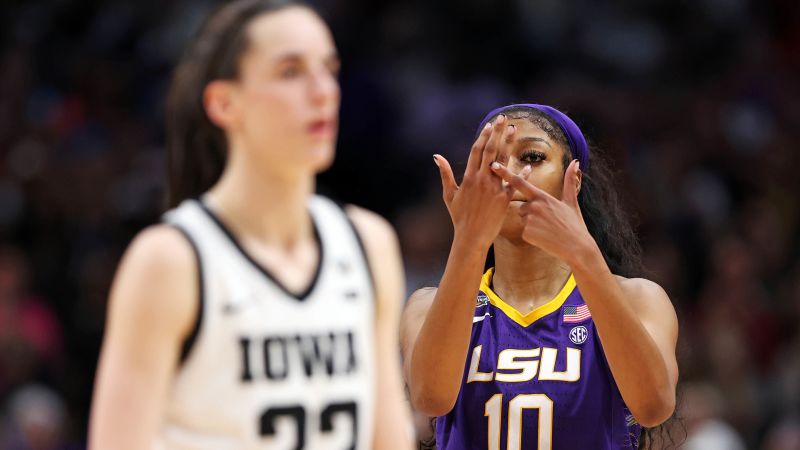
The 2023 NCAA women's basketball national championship game between the Louisiana State University (LSU) Tigers and the Iowa Hawkeyes concluded with LSU securing their first-ever title. The game, which captivated a significant national audience, was marked by intense competition and notable individual performances. Towards the end of the contest, an interaction involving LSU forward Angel Reese and Iowa guard Caitlin Clark garnered considerable attention, becoming a focal point of post-game discussions.
LSU's victory capped a remarkable season for the team, culminating in a historic achievement for the institution's women's basketball program. The game itself was a high-scoring affair, showcasing the offensive talents of both teams and the strategic approaches of their respective coaching staffs. The competitive nature of the matchup, combined with the high stakes of a national championship, created an environment where emotions ran high among players and fans alike.
Reese's Gesture and Subsequent Commentary
In the final moments of the championship game, Angel Reese made a gesture in the direction of Caitlin Clark, pointing to her ring finger and tapping her hand in front of her face. This action quickly circulated across social media platforms, sparking a wide range of reactions and interpretations. Following the game, Reese was asked about the gesture during a press conference, where she offered her perspective on the incident.
Reese stated that her actions were a response to perceived disrespect, asserting, "I don't take disrespect lightly." She further elaborated that she had observed similar gestures made by Clark in previous games, particularly during Iowa's Elite Eight victory over Louisville. Reese indicated that she felt it was appropriate to reciprocate the gesture in the context of their championship win, emphasizing her belief in holding individuals accountable for their on-court behavior.
Discussions on Sportsmanship and Double Standards
Reese's comments ignited a broader conversation about sportsmanship, gender, and racial dynamics within collegiate athletics. She articulated a view that there exists a double standard in how male and female athletes, and specifically Black and white female athletes, are perceived and judged for expressing emotion or engaging in competitive displays. Reese suggested that male athletes often receive praise for similar actions, which are sometimes labeled as "trash talk" or "competitive fire," while female athletes may face harsher criticism.
She highlighted that she embraces being "unapologetically" herself and that her confidence should not be misconstrued as arrogance. Reese's stance resonated with many who argue that female athletes, especially those of color, are frequently subjected to different scrutiny levels compared to their counterparts. This perspective posits that such double standards can limit the authentic expression of athletes and perpetuate unfair biases in sports commentary and public perception.
Public and Media Reactions
The incident and Reese's subsequent defense generated extensive discussion across traditional and social media. Some commentators and fans condemned Reese's gesture as unsportsmanlike, arguing that it detracted from LSU's victory and the spirit of competition. Others defended Reese, aligning with her assertion about double standards and praising her for her authenticity and competitive drive.
Caitlin Clark, when asked about the gesture, downplayed its significance, stating that she did not see it in the moment and that it was part of the game. Her response, which largely focused on her team's performance and the overall experience of the tournament, contributed to a more measured perspective amidst the heated debate. The diverse reactions underscored the complex nature of sportsmanship, individual expression, and the ongoing dialogue surrounding equity in sports.
Broader Implications for Women's Basketball
Beyond the immediate controversy, the championship game and the discussions surrounding it brought unprecedented attention to women's college basketball. The record-breaking viewership for the final game indicated a growing national interest in the sport, moving it into a more prominent position within the broader sports landscape. The passionate displays and compelling narratives, including the post-game commentary, contributed to the sport's increased visibility and engagement.
The conversation initiated by Reese's comments also served to highlight important societal discussions about race, gender, and perception in high-profile competitive environments. It prompted a re-evaluation of how athletes are expected to behave, how their actions are interpreted, and the underlying biases that may influence public discourse. This increased scrutiny, while sometimes contentious, ultimately contributes to a more nuanced understanding of the evolving dynamics within sports and society.
Source: Original Article
Related Articles
 sports
Major Golfers Face Disappointment in Open Qualifying Rounds
 sports
EFL Clubs Anticipate Fixture Release and Carabao Cup Draw Details
 sports
UConn and San Diego State Vie for National Championship in Historic March Madness Finale
 sports