
Unveiling the Depths: A New Benchmark for Deep-Sea Exploration
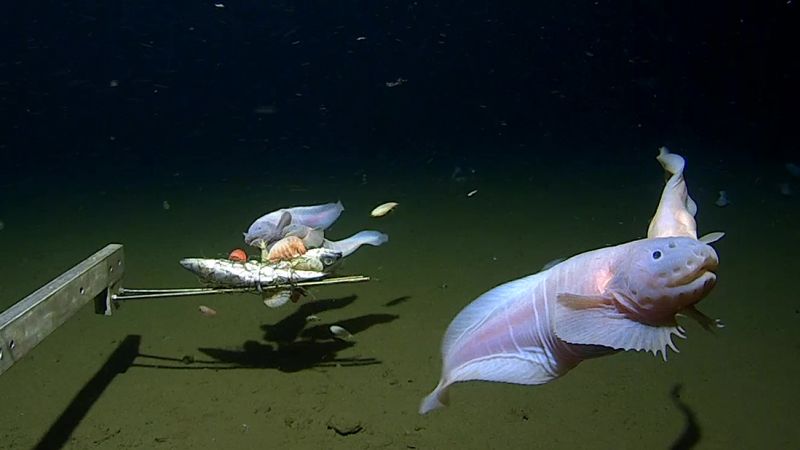
In a significant development for marine biology, a team of scientists has successfully filmed a snailfish at a remarkable depth of 8,336 meters (approximately 27,350 feet) in the northern Pacific Ocean. This observation, conducted just above the seabed, establishes a new record for the deepest fish ever recorded by scientific instrumentation. The discovery offers invaluable insights into the adaptability and resilience of life in the planet's most extreme environments, pushing the boundaries of what was previously understood about the distribution of marine species.
The expedition, part of a broader study into the abyssal plains, utilized advanced deep-sea vehicles equipped with specialized cameras capable of withstanding the immense pressures found at such profound depths. The footage captured depicts a juvenile snailfish, an organism typically characterized by its gelatinous body and lack of scales, navigating an environment previously thought to be largely inhospitable to complex vertebrate life. This finding not only redefines the known depth limits for fish but also prompts further questions about the physiological mechanisms that allow these creatures to thrive under such extraordinary conditions.
Technological Advancements Pave the Way for Deeper Discoveries
The success of this expedition is largely attributable to the continuous advancements in deep-sea technology. Remotely Operated Vehicles (ROVs) and autonomous underwater vehicles (AUVs) have become increasingly sophisticated, allowing researchers to explore areas of the ocean that were once completely inaccessible. These vehicles are designed to withstand pressures exceeding 1,100 times that at sea level and are equipped with high-definition cameras, lighting systems, and sampling tools that enable detailed observation and data collection.
The ability to deploy these instruments for extended periods in extreme conditions has opened new frontiers for scientific research. Prior to this, many of the deepest parts of the ocean remained largely unexplored, with much of our understanding based on theoretical models or limited sampling. The visual confirmation of a fish at this depth provides tangible evidence that complex ecosystems exist in these dark, cold, and high-pressure environments, challenging previous assumptions about the limits of biological existence.
The Snailfish: A Master of Extreme Environments
Snailfish, belonging to the family Liparidae, are known for their ability to inhabit deep-sea environments. However, the depth at which this particular specimen was filmed significantly surpasses previous records. These fish possess unique adaptations that enable them to survive in conditions that would be lethal to most other vertebrates. Their bodies are primarily composed of a jelly-like substance, which helps them withstand extreme pressure by reducing the need for rigid structures that could collapse.
Furthermore, snailfish have evolved specialized proteins and osmolytes in their cells that prevent their proteins from denaturing under high pressure. Their metabolic rates are also typically lower, conserving energy in an environment where food sources are scarce. The observation of a juvenile snailfish at such a depth suggests that these adaptations are present early in their life cycle, highlighting the remarkable evolutionary strategies employed by deep-sea organisms to colonize and thrive in the most challenging habitats on Earth.
Implications for Marine Biology and Conservation
This groundbreaking discovery has profound implications for marine biology and our understanding of biodiversity. It underscores the vast extent of unexplored marine ecosystems and the potential for discovering new species and ecological interactions. The deep sea, often referred to as the last frontier on Earth, plays a crucial role in global biogeochemical cycles and harbors unique biodiversity that is still largely unknown.
The findings also contribute to ongoing discussions about the impact of human activities on deep-sea environments. As technological capabilities advance, so does the potential for human interaction with these fragile ecosystems, particularly through activities such as deep-sea mining. Understanding the full extent of life in these depths is critical for developing effective conservation strategies and ensuring the protection of these unique habitats before they are irreversibly altered.
Future research will undoubtedly focus on further exploring these extreme environments, aiming to uncover more about the physiology, behavior, and ecological roles of the organisms that call them home. The record-breaking snailfish serves as a powerful reminder of the ocean's enduring mysteries and its capacity to continually surprise and inspire scientific inquiry.
Source: Scientists film deepest ever fish on seabed off Japan
Related Articles
 technology
Twitter's Verification Policy Shift: The New York Times Singled Out Amidst Broader Changes
 technology
China Initiates Cybersecurity Review of Micron Technology Amidst Escalating Tech Tensions
 technology
Novel Nasal Vaccine Strategy Shows Early Promise Against COVID-19
 technology