
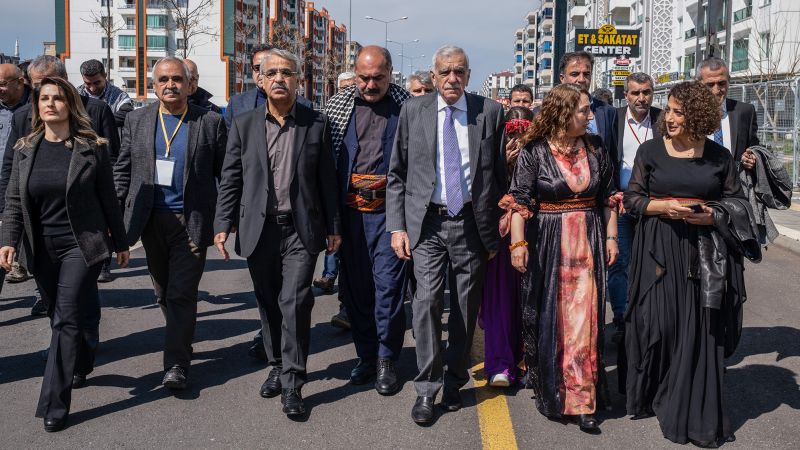
The Shifting Political Landscape in Turkey
As Turkey approaches a pivotal election, the political landscape is marked by an unusual dynamic, with the pro-Kurdish Peoples' Democratic Party (HDP) finding itself in a position of significant influence. Historically marginalized and often subjected to political pressure, the HDP's strategic decisions could now determine the trajectory of Turkish leadership, particularly regarding the two-decade tenure of President Recep Tayyip Erdogan.
The HDP, while not directly fielding a presidential candidate in this election cycle due to ongoing legal challenges and a perceived hostile political environment, holds considerable sway over a substantial voting bloc. Its endorsement, or lack thereof, for either the incumbent or the opposition alliance, is anticipated to have a tangible impact on the final results. This scenario underscores the complex interplay of ethnic, political, and social factors that define Turkish democracy.
The Kurdish Vote: A Historical Overview
The Kurdish population in Turkey represents a significant demographic, and their political aspirations have long been a central, often contentious, issue in the country's domestic affairs. For decades, Kurdish political movements have navigated a challenging path, advocating for greater rights, cultural recognition, and a peaceful resolution to the long-standing conflict in the southeastern regions of Turkey. Parties representing Kurdish interests have frequently faced accusations of links to militant groups, leading to arrests, parliamentary expulsions, and even party closures. This history of repression has, in turn, solidified a sense of collective identity and political solidarity among many Kurdish voters.
Despite these challenges, the HDP has consistently demonstrated its ability to mobilize a considerable portion of the electorate. In past elections, the party has crossed the high 10% national election threshold, a benchmark designed to limit smaller parties' representation, thereby securing its presence in the Grand National Assembly. This consistent electoral performance highlights the enduring political power of the Kurdish community and its representatives, even under duress.
Erdogan's Two-Decade Rule and Opposition Challenges
President Recep Tayyip Erdogan, who has dominated Turkish politics for over two decades, first as Prime Minister and then as President, faces what many observers consider his most significant electoral challenge yet. His AK Party (Justice and Development Party) has overseen a period of considerable economic growth and infrastructure development, but also a consolidation of power and a more assertive foreign policy. Critics, however, point to concerns regarding democratic backsliding, human rights, and economic instability in recent years.
The opposition, a diverse coalition known as the Nation Alliance, has united around a single presidential candidate, Kemal Kilicdaroglu, leader of the Republican People's Party (CHP). This alliance, comprising parties from across the political spectrum, aims to capitalize on public discontent and present a united front against Erdogan's long rule. Their platform largely focuses on restoring democratic norms, strengthening the rule of law, and addressing the country's economic woes.
The HDP's Strategic Position
Given the tight electoral race anticipated, the HDP's decision on how to direct its voters becomes paramount. While the party has not officially endorsed a presidential candidate, its leadership has signaled a preference for a change in government, implicitly favoring the opposition. This stance is rooted in the HDP's long-standing grievances against the current administration, which it accuses of systematic oppression and marginalization of the Kurdish community. The party's decision to support the opposition, even without a formal endorsement, could translate into a significant number of votes shifting away from Erdogan.
The HDP's leverage also stems from its ability to influence parliamentary elections. Even if their presidential leanings are clear, the party's performance in the parliamentary race will be crucial for the overall balance of power. A strong showing could see them hold the balance in the legislative body, further complicating governance for any incoming administration.
Potential Outcomes and Implications
The potential scenarios are varied. Should the HDP's influence lead to a victory for the opposition, it would herald a significant shift in Turkish politics. Such an outcome would likely necessitate a re-evaluation of policies concerning minority rights, democratic institutions, and potentially even foreign relations. The opposition, in turn, would face the challenge of governing a deeply polarized nation while attempting to deliver on its promises of reform.
Conversely, if Erdogan manages to secure another term despite the HDP's opposition, it would underscore his enduring political resilience and the limitations of a fragmented opposition. However, even in this scenario, the role of the Kurdish vote would remain a critical factor, demonstrating its capacity to shape the narrative and potentially narrow the margin of victory. The current election cycle is therefore not just about a change in leadership, but also about the evolving dynamics of political power and representation in Turkey, with the Kurdish electorate at its heart.
Source: Erdogan's political fate may be determined by Turkey's Kurds
Related Articles
 world
world
McLaren and Red Bull Challenge Monaco GP Results Over 'Tricky Precedent'
 world
world
Haggis: A Culinary Divide Between Scotland and the United States
 world
world
Investigating the Potential Link Between Drinking Water Lithium Levels and Autism Spectrum Disorder Risk
 world
world